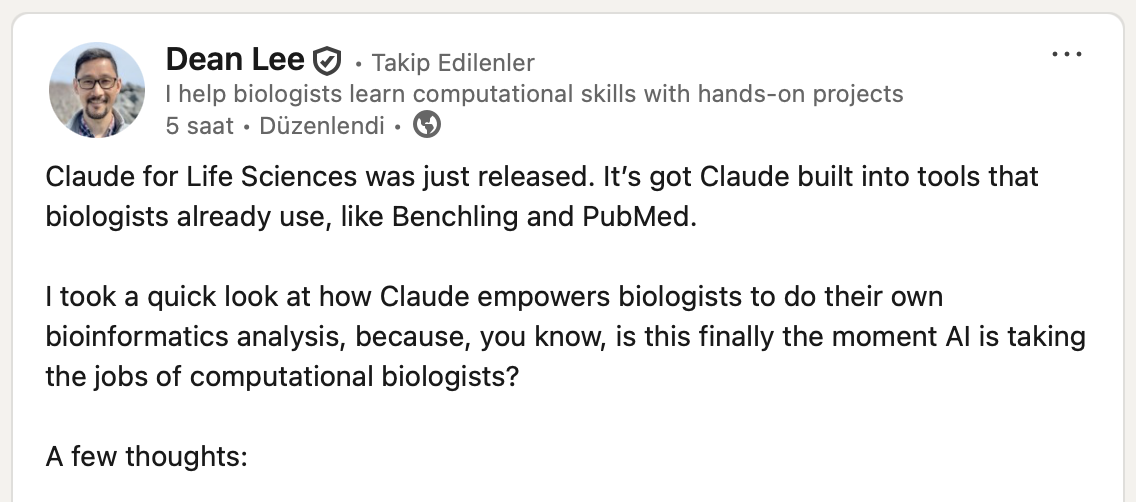
A few days ago, Dean Lee published a thoughtful post on LinkedIn about the release of Claude for Life Sciences—a version of the Claude AI assistant now integrated into tools like Benchling and PubMed. In his post, he explored whether this is the moment AI begins to truly take over the work of computational biologists, or whether it simply reflects a shift in how we work.
He praised Claude’s ability to empower biologists to run their own exploratory analyses, but also raised some serious concerns: that the results may look convincing even when they’re not, that reproducibility could suffer, and that quality control may become even more burdensome. His central takeaway? Claude won’t replace computational biologists—it may just make their job more critical than ever.
This sparked an insightful community-wide conversation that raised key questions about the role of automation in scientific research. In this post, we explore the core themes that emerged—grounded in recent literature—and ask: what does AI offer life scientists, and what does it demand in return?
Claude offers something powerful: the ability for scientists without coding experience to conduct complex analyses with just a few natural language prompts. In that sense, it democratizes access to computation.
However, being able to generate an analysis doesn’t mean the user fully understands its assumptions, limitations, or scientific validity. Research shows that tools like Claude are only as good as the prompts they’re given—and when those prompts are vague or technically incorrect, the output may be misleading yet still look persuasive. This is a classic case of automation bias, where humans tend to over-trust machine-generated results [(Goddard et al., 2012)].
These tools are most effective when used by researchers who can critically evaluate what the AI produces—not just when they simplify the process, but when they understand the science behind it.

A central issue with language models like Claude is their non-deterministic nature. The same input doesn’t always lead to the same output. In scientific work—where reproducibility is a cornerstone—this unpredictability poses a major risk.
The problem is compounded when outputs aren't systematically documented. If Claude generates an analysis or a gene list, but doesn’t produce a fully transparent, well-structured notebook, there’s no clear way to audit what was done. That makes validation nearly impossible and leaves collaborators or reviewers in the dark.
Literature in both medicine and bioinformatics warns of this opacity. Beam & Kohane (2018) emphasize the need for transparency in AI-assisted clinical research. And reproducibility isn’t just about repeating steps—it’s about understanding what was done and why [(Beam & Kohane, 2018)].
One of the less visible challenges in AI-assisted science is the asymmetry between what users can do with a tool and what they actually understand. Many biologists are strong in domain expertise but may lack computational skills. On the other hand, software engineers entering life sciences may lack context for experimental design or biological interpretation.
This divide can lead to misleading conclusions or overconfidence in tools like Claude. For instance, just because a model can generate a visually compelling heatmap doesn’t mean the underlying statistics are sound—or that proper controls were applied.
Studies have long pointed to the challenges of interdisciplinary work in bioinformatics. Mangul et al. (2019) highlight how poor documentation, lack of testing, and spaghetti-code practices undermine reproducibility and quality in computational pipelines. AI won’t fix that by default—in fact, it can accelerate the mess if critical thinking isn’t applied [(Mangul et al., 2019)].
Another pressing issue is whether Claude-generated outputs are actually valid. If we can’t answer fundamental questions—like how the data were normalized, what statistical assumptions were made, or what the confidence levels are—then we’re not doing science, we’re just performing statistical theater.
This becomes more worrying when AI-generated code is used without scrutiny. Fast doesn’t mean rigorous. And while Claude can produce working scripts, it doesn’t guarantee well-documented, testable, or version-controlled workflows.
The scientific community has been here before: rapid tool development without quality standards often leads to results that can’t be trusted. AI-generated code must be treated with the same skepticism and rigor as any manually written script.

Contrary to popular belief, Claude may not reduce the total workload in life sciences research—it may simply redistribute it. While it can speed up the initial analysis, it increases the burden on later stages like validation, reproducibility checks, and peer review.
This aligns with broader patterns observed in research and management literature. Brougham & Haar (2018) describe how AI tends to displace tasks rather than eliminate them—shifting the focus from execution to supervision, from doing to verifying [(Brougham & Haar, 2018)].
Claude doesn’t remove the need for experts. It moves them to a different part of the workflow, where their critical judgment is needed more than ever.
There’s no doubt that tools like Claude are transformative. They make research faster, more accessible, and in some ways, more exciting. But they also create new scientific challenges—particularly around rigor, reproducibility, and interpretation.
Dean Lee’s reflection reminds us of a crucial truth: AI doesn’t replace scientific responsibility—it reshapes it. These tools demand more from us, not less. If we want to generate real knowledge—not just good-looking outputs—we still need humans in the loop, transparent workflows, and a deep respect for the scientific method.
Claude can help us get there. But we still have to walk the path.
Beam, A. L., & Kohane, I. S. (2018). Big Data and Machine Learning in Health Care. JAMA, 319(13), 1317–1318. https://doi.org/10.1001/jama.2017.18391
Mangul, S., et al. (2019). Challenges and recommendations to improve the installability and archival stability of omics computational tools. PLoS Biology, 17(6), e3000333. https://doi.org/10.1371/journal.pbio.3000333
Karp, P. D., et al. (2023). Large Language Models in Bioinformatics: Opportunities and Limitations. Bioinformatics Advances, 3(1), vbad004. https://doi.org/10.1093/bioadv/vbad004
Brougham, D., & Haar, J. (2018). Smart technology, artificial intelligence, robotics, and algorithms (STARA): Employees’ perceptions of our future workplace. Journal of Management & Organization, 24(2), 239–257. https://doi.org/10.1017/jmo.2017.47
Goddard, K., et al. (2012). Automation bias: a systematic review of frequency, effect mediators, and mitigators. JAMIA, 19(1), 121–127. https://doi.org/10.1136/amiajnl-2011-000089